
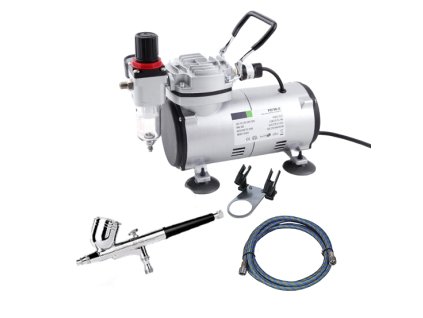
Fengda Airbrush Set - Airbrush BD-130 + Compressor AS-186 + Hose BD-24
Code: FENGDA-AS-186K1


Related products










Product detailed description
Complete airbrush and compressor set includes everything you need to get started right away.
Set contents:
Air Compressor AS-186
Motor: 220-240V 50Hz /110-120V 60HZ
Speed: 1450 rpm/ 1700 rpm
Auto-Stop at 4Bar; Auto Re-Start at 3bar
Max. pressure: 57 psi (4 Bar)
Output flange: 1/8"
Air flow rate: 23 l/min
Power: 1/5 HP
Auto stop, pressure gauge; pressure regulator; air filter
Weight: 5 kg
Air tank volume: 3l
Dimensions: 310 x 135 x 310 mm
Power cable: 1.6 m
Noise: 47db
Airbrush BD-130
Filling: gravity
Nozzle diameter: 0.3mm
Container capacity: 7cc
Working pressure: 15-50psi
Double-acting mechanism
BD-24 hose 1.8m
Mini airbrush holder
Paint dilution: The paint should be very thin, only then can it be sprayed. It is necessary to try the dilution and spraying before starting work. The dilution ratio also affects the adhesion of the paint and its covering ability. Different brands and types of paint require different dilutions.
Air source - compressor: The working pressure of spray guns ranges between 0.8 - 2.7 bar, depending on the type of gun and the work. The compressor must have continuous pressure regulation and a separator filter to capture dirt and water vapor. Some airbrush compressors have a pressure vessel (air tank), which serves to ensure the most uniform air pressure at the outlet.
airbrush operation
Try spraying on a piece of paper or a practice object. Make sure that the hose connecting the compressor and the gun is well sealed. Fill the container with paint. When starting to spray, set the gun to a fine stream of paint and start spraying about 15cm from the surface. Hold the gun at a right angle to the surface. While spraying, make a smooth movement of your hand from side to side, never stand with the gun in one place. Guide the gun evenly along the surface and cover a continuous strip. If you get closer to the surface, the painted area will be smaller and the paint more concentrated. If you move the gun away, the painted area will be larger and the paint less concentrated. After gaining practice, you can try spraying fine lines. Hold the gun just above the surface and carefully control the amount of paint. In this spraying mode, the tip of the needle protrudes from the spray head. Be very careful not to catch it on the surface. The tip of the needle is sensitive, it could bend.
Cleaning and maintenance: In order for the gun to work well for a long time, you must always clean it thoroughly, but very carefully. Two principles for a well-functioning airbrush are cleaning and general care. When working with multiple paint shades, it is not always necessary to clean the gun completely. Usually, it is enough to rinse with a small amount of thinner and continue working immediately. Thorough cleaning is only necessary after the work is completely finished.
Regular cleaning:
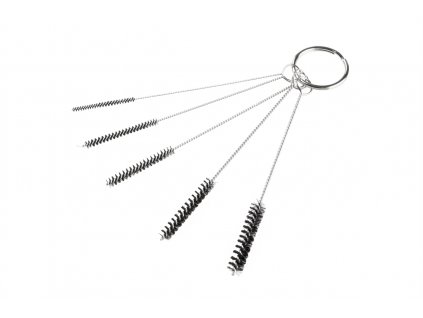
-Fill the gun container with a special liquid cleaner. Water is not effective in this case, even if you have worked with water-thinned paints. Unlike regular thinner, the Airbrush Cleaner also dissolves dried paint residues inside the gun. Use a brush or a brush to clean all surfaces inside the gun. Then pour out the cleaner along with the paint residues.
-Refill the container with cleaner and spray it into the collection container (it can be reused). You can also carefully (be careful of the needle tip) block the spray head with your finger for a while so that bubbles begin to form in the gun container. This will help clean the channels in the gun better. Repeat the process until the gun is completely clean.
Thorough cleaning:
-Unscrew the back of the gun body, unscrew the needle lock nut. Carefully pull out the needle. If there is paint residue on it and the needle does not come out easily, carefully grip it with pliers and slowly pull it out with a twisting motion. Clean the needle carefully, with a soft cloth. Pay close attention to the needle tip. If you manage to bend the needle tip, press it on a flat surface (glass) and roll it a few times with the tip of your finger.
-After pulling out the needle, unscrew the spray head parts and clean them of paint residue on the inner surfaces.
-Cleaning the nozzle is just as delicate an operation as cleaning the needle. You can usually clean the screw-on nozzle without removing it from the gun. The nozzle in a new gun is sealed on the thread with wax from the factory and unscrewing it will break the seal and there is a risk of damaging the nozzle. Sometimes it is advisable to carefully heat the nozzle to loosen the wax. If you want to replace the nozzle with another one, you should be extremely careful when unscrewing the nozzle. In newer types of guns, the nozzle is sealed with a rubber seal, which makes unscrewing easier. You can easily release the VEGA type nozzle from the bed by pressing your finger on the side of the nozzle. Then clean the nozzle bed as well.
Note: Each nozzle is subject to wear depending on the type of paint used. Paint is an abrasive and the nozzle will wear out sooner or later with use.
- Cleaning the trigger mechanism and the rear part of the gun is necessary if it is heavily soiled. During normal operation, it is enough to completely disassemble the gun only once in a while, when you feel that the overall operation of the gun has deteriorated.
-To assemble the airbrush, proceed in reverse order. First assemble the spray head (tighten the threads carefully with your fingers so as not to tear them!), then continue with the trigger and needle bed assembly. Then insert the needle and gently push it in with your finger until it stops. As soon as you feel resistance, stop pushing on the needle and tighten the lock nut. Be very careful when pushing the needle in so as not to tear the nozzle!
-Rubber seals may change size when in contact with cleaner. However, after cleaning, they will regain their original shape in about 15 minutes.
-If you will not be using the gun for a long time, you can preserve it with a fine oil.
The product warranty is 24 months from the date of sale. It does not apply to operational wear of the product and damage caused by improper handling, incorrect use, or neglected maintenance.
Safety
1. Do not use the compressor for any purpose other than that for which it was designed and manufactured.
2. Do not modify or repair the compressor while it is plugged into the power supply.
3. This is an electrical device that can cause injury or death if used incorrectly and if the structure is tampered with. Warning: Any unauthorized tampering with the structure and electrical installation of the compressor can cause injury or death, or damage to property. It also voids the warranty for this product. The warranty is also limited by improper use of this device. Children may only use it under adult supervision. It is not intended for use in a humid environment, and do not turn it on in an environment with concentrated flammable vapors, as this may cause a fire. Excessive overloading and operation in an unsuitable environment can damage or destroy the compressor. It is intended mainly for indoor and clean environments.
4. The compressor has an automatic pressure safety device. If it is switched on and the air is not being drawn by the airbrush, the compressor will switch off automatically when the set pressure is reached. When the trigger on the airbrush is pressed, the compressor will switch on again automatically.
5. The pressure tank has a safety valve that is used to release excess air from the tank in the event of a malfunction of the automatic compressor shutdown. Never block this pressure safety valve or prevent its function in any way!
Use
1. Place the compressor on a flat surface of appropriate size in a dry, well-ventilated room where the air temperature is not higher than 35C.
2. Connect a hose to the compressor outlet using a screw fitting. To improve the tightness of the connection, you can use Teflon tape to seal the thread. Then plug the power cord into the 220 V / 50 Hz power supply and turn on the 0/I switch.
3. If the compressor heats up above the safe limit during prolonged operation, it will automatically switch off using a thermal fuse. After cooling down for approximately 20 minutes, it will start up again by itself.
4. The air pressure at the outlet from the compressor to the hose can be adjusted using the plastic adjustment screw on the control valve. After unlocking it by pulling it up, the screw can be turned to the right and left, thus changing the output pressure. After setting the required pressure, the screw is locked by pushing it down.
5. The pressure vessel has the function of damping air shocks so that the pressure and air flow coming to the airbrush are as even as possible (this has a significant impact on the quality of work). It is not a pressure vessel in which the compressor would accumulate a large amount of air and then switch off. After switching on, the compressor only presses a relatively small amount of air into the vessel and switches off automatically after reaching a pressure of 4 bar. If you start to remove air from the air tank, the compressor will turn on by itself after a short while and continuously add air to the air tank.
Compressor maintenance
1. Clean the compressor after each use to remove any dirt on the surface.
2. In intensive use, blow out the water that condenses in the separator filter once a week through the vent screw at the bottom of the filter container. Depending on the separator filter version, the condensate is drained by pressing or turning the valve at the bottom of the glass container. This opens the vent. The compressor must be running during this operation.
3. In intensive use, clean the disassembled separator filter once every three months by blowing through the compressor.
4. Approximately once a month, unscrew the drain valve at the bottom of the air tank and pour out any condensed water. Let the compressor run for a while and blow out any condensate residue through the drain hole.
5. After finishing work, before putting the compressor away, pull the eye of the pressure relief valve and drain the air from the air tank.
Good advice:
When adjusting the air pressure on the regulator, it is necessary to remember which reading the pressure gauge shows. The air pressure is correctly adjusted by holding the trigger on the airbrush. This way you set the actual working air pressure. If you have the trigger on the gun released, the pressure gauge will show the air pressure in the hose, which is higher, because the hose is acting as a pressure vessel at that moment. Therefore, when you press the trigger on the gun, the pressure gauge will immediately show a drop in pressure.
If you work in the summer (higher air humidity) in a cold room with a cold floor, place the compressor on a table and make sure that the hose is not placed on the ground. In a special combination of higher humidity and warm air, which is even more heated by passing through the compressor, water can condense in the hose lying on the cold floor and, despite the separator filter, this water can get into the airbrush and make work very unpleasant. These are unique cases, but we know them from our own experience.
Additional parameters
| Category: | Airbrush and Compressor sets |
|---|---|
| Warranty: | 2 years |
| Weight: | 5 kg |
| ? Configuration: | Double action |
 Code: FENGDA-AS18-2K1


Be the first who will post an article to this item!
Fenhua Bida Machinery Manufacture Co., Ltd, vlastník značky Fengda.
Čínsky líder vo výrobe airbrush striekacích pištolí a bezolejových kompresorov s ročnou produciou viac ako 500000 striekacích pištolí a 200000 kompresorov. Samozrejmosťou je aj výroba širokého sortimentu príslušenstva.
| Manufacturing company : | Ningbo Bida Machinery Manufacture CO., LTD |
|---|---|
| Address : | 25 Nandu Rd., Jiangkou Str., Fenghua District, Ningbo City, Zhejiang Province, China 315504 |
| E-mail : | zmg@cnbida.com |
| EU representative of the manufacturer : | Ing. Jozef Anďal - HT model |
| Address of the EU representative : | HTmodel Na letisko 49 05801 Poprad Slovensko |
| Email of the EU representative : | htmodel@htmodel.sk |