
Kavan Li-Pol Battery 3250mAh/14.8V 30/60C Airpack Without Connector
Code: KAVAN-KAV33.71300


Related products





Product detailed description
KAVAN LiPo battery pack with charging up to 2C and discharging 30/60C. Four-cell 4s1p 14.8 V 3250 mAh, dimensions: 136x42.5x27mm, weight 317g, JST-XH service connector.
KAVAN lithium polymer batteries of the 30/60C series reliably cover the needs of a recreational modeler: they have a maximum discharge current of 30C, the possibility of fast charging 2C, a wide range of capacities (350-3250 mAh), excellent long-term service life and a favorable price.
KAVAN lithium polymer batteries of the 30/60C series with a current load capacity of max. 30C are designed for common applications in recreational and sports aircraft models for classic and 3D aerobatics. High current capacity guarantees maximum use of engine power and allows for a relatively aggressive flying style while maintaining a very good long-term service life.
Do not charge KAVAN 30/60C series batteries with a current greater than 2C, for normal operation we recommend using currents in the range of 1-2C. We recommend using a balancer with each charge. KAVAN 30/60C series batteries do not require initial conditioning, but if you intend to charge the sets with a current greater than 1C, we recommend not exceeding 1C for the first three charging cycles. It is not necessary to discharge them before charging - e.g. you can safely charge batteries discharged to 50%.
The set is supplied in the "Air Pack" version intended primarily for powering model airplanes and helicopters. It is equipped with silicone power (charging) cables with a cross-section dimensioned with regard to the expected current load (without connectors). The service connector is of the standard JST-XH system type – it has small dimensions and low weight (which is especially appreciated by users of small capacity kits), has simple connection of the terminals and can even be connected directly to the balancer sockets on many KAVAN, RAYTRONIC, SkyRC, GT Power chargers, etc. without using any adapter.
The kit includes: KAVAN battery 30/60C series, instructions.
Capacity [mAh] 3250
Voltage [V] 14.8
Charging current [A] 3.2 - 6.5
Max. charging current [A] 6.5
Discharging current [A] 97.5
Max. discharging current [A] 195
Energy [Wh] 47.5
Length [mm] 136
Width [mm] 42.5
Height [mm] 27
Weight [g] 317
Modeling Lithium accumulators.
In modeling practice, you will encounter various types of lithium batteries: Li-Pol (Li-Po), Li-Ion, Li-Fe (Li-Fe-Po4), Li-HV. The differences are in the internal construction and features. These accumulators generally do not suffer from the so-called memory effect", they do not have to be discharged before charging and have a small self-discharge.
In high-performance RC models of cars, airplanes or helicopters, Li-Pol batteries (nominal voltage 3.6-3.7V per cell) are most often used, which have the ability to release a lot of energy in a short time. The tax for high performance is the construction, which is made of "soft cushions" and with improper use or overloading there is a risk of damage and spontaneous combustion of these accumulators. Therefore, it is necessary to constantly check them and protect them from damage.
Note: Li-HV (Li-Pol HV) is the latest type of Li-Pol accumulators, which has an increased maximum charging voltage to 4.35 V per cell, and thus it is possible to get approximately 15-20% more energy into the accumulator than with Li -Pol.
In models less demanding on a large amount of energy (RC tanks, trucks, crawlers), Li-Ion type accumulators (nominal voltage 3.6-3.7V per cell) are increasingly used, which have very good properties when used correctly, mainly better endurance. They are more durable than Li-Pol and more user-friendly.
Another type is Li-Fe (Lithium-iron-phosphate), which mainly increases the safety of operation. The working voltage of these cells is 3 - 3.3 V. They are usually used as receivers or transmitters.
All Li-XX batteries:
- Due to their chemical composition, they have a working temperature range of approx. 5° to 40°C.
- They are subject to aging and loss of properties regardless of whether they are used or not.
- They are sensitive to the same charging of all cells in the set, therefore charging with a quality charger with a balancer is recommended.
- They are sensitive to undercharging below 2.7V
- They are sensitive to the ambient temperature, they quickly lose performance at low temperatures
- They are sensitive to the principles of proper handling, and if damage is suspected, you must take them out of service and have them disposed of ecologically.
The advice below applies in general to all types of lithium batteries, they are focused on the most used type Li-Pol.
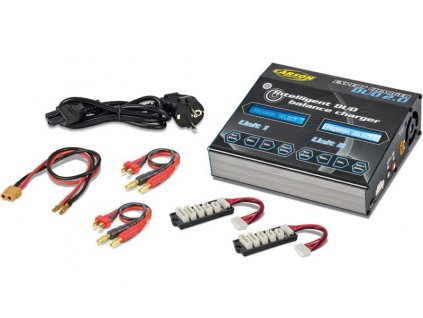
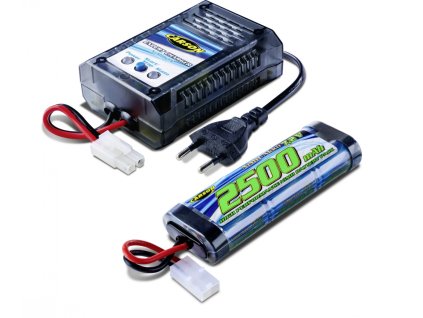
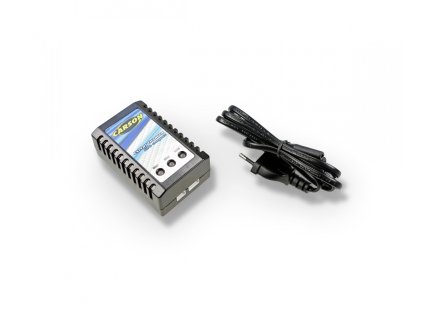
Good advice: Inexpensive or USB charging adapters, such as are usually attached to finished RC models, are mainly used for initial testing and occasional charging. For high-quality regular battery charging, it is best to buy a charger with programmable charging parameters. This will extend the life of the batteries and save you money.
Example of calculating the charging time: If you use a cheap charging adapter, you calculate the approximate charging time by dividing the battery capacity (for example, 2000 mAh) by the output power of the charging adapter (shown on the nameplate of the adapter, for example: Output 350 mA), and the resulting number means the charging time completely discharged battery. Example: 2000 : 350 = 5.7 hours. A less discharged battery will charge for a shorter time. However, do not leave it charging for longer, overcharging damages the battery.
User hints:
The standard nominal voltage of a Li-Pol monocell is 3.7V. Fully charged it reaches 4.2V. Each Li-Pol battery pack, i.e. a two or more cell battery, should have two thicker power cables (red and black) used to connect the battery to the device and a bundle of thin service cables used for diagnostics and control of the charging process. The biggest weakness of Li-Pol accumulators is the sensitivity to the exact same charging of all cells in the set. If for some reason, for example, in a three-cell battery you charge one cell more and another less, the less charged cell will discharge earlier when using the battery. If its voltage drops below 2.7V, the cell is usually destroyed and that means the end for the whole set. Therefore, if you want the Li-Pol battery to serve you well, always charge it on a programmable charger in Li-Pol mode, which charges via the power cable and balances the voltage of the cells during charging so that at the end all the cells in the set are perfectly equal loaded. Model manufacturers include simple chargers in RTR kits that charge the Li-Pol batteries via service cables to ensure a somewhat correct charge, but this is unreliable.
Never store them fully discharged. High-quality programmable chargers have a "storage" program that charges the Li-Pol battery so that it can then be stored for a long time. If you don't have a charger with such a program, charge the battery to 75% (3.8V per cell) and only then put it away.
You should know that Li-Pol batteries are sensitive to impacts and any damage. Always handle them with care and make sure they don't fall on the ground, or check the condition of the battery after every crash of the model.
For RC cars, use Li-Pol batteries in plastic cases marked Hardcase.
Make sure your ESC controller is set to Li-Pol mode, which monitors the battery voltage and disconnects it in time to avoid undercharging. If you use an ESC controller that does not have a Li-Pol mode, use at least a small external voltage detector with a siren.
A typical symptom of a damaged Li-Pol battery is swelling into a "pillow". Slight swelling can still be ignored, and with careful handling, you can continue to use the battery. However, if the battery is inflated "to the point of bursting", it is already dangerous and should be taken to the junkyard as soon as possible. Attention, never underestimate the danger of an inflated or otherwise damaged Li-Pol battery. It can catch fire and cause property damage or injury. This is also why it is recommended to always charge Li-Pol batteries "in sight" and placed on a non-flammable pad. Therefore, special charging and transport packaging for Li-Pol accumulators are produced.
When driving or flying in temperatures below 10C, keep the battery in a warm place before use (heated car interior, inner jacket pocket...). Frost definitely does not do well with this battery.
The life of the battery depends on the way it is used, discharged, charged and stored. The ambient temperature, possible overheating or undercooling of the accumulator also has an effect. Usually, the service life is calculated on the number of charging cycles 30-50 and not on time. The service life can be significantly shorter than 2 years. As the number of cycles increases, the "performance" of the battery begins to decrease, which means that you will drive less than when it was new. When the battery gets old, its internal resistance increases and it so-called softens. While charging, it will show a charged capacity, but the power will be low.
The battery is a consumer product. Only manufacturing defects are covered by the warranty (if they are, they usually become apparent immediately upon first use). Decreasing capacity or generally deteriorated properties caused by use or long-term storage are not covered by the warranty. A battery with a voltage lower than 2.7V per cell caused by improper use cannot be claimed.
Additional parameters
| Category: | Li-Pol accumulators |
|---|---|
| Warranty: | 2 years |
| EAN: | 8596450029255 |
| ? Capacity mAh: | 3000 - 3900 |
| ? Voltage V: | 14,8 |
| ? Power connector: | Without connector |


Be the first who will post an article to this item!
Veľký výrobca a distribútor širokého sortimentu príslušenstva pre RC modely všetkých druhov, nabíjačiek, akumulátorov a všetkého čo RC modelár potrebuje.
| Manufacturing company : | KAVAN Europe s.r.o |
|---|---|
| Address : | Doubravice 110 Pardubice 533 53 Czech Republic |
| E-mail : | info@kavanrc.com |